Tag Archives: Balance

Meditation. It’s not just for Sissies anymore.

(Watch out phone viewers…quite a few videos below)

Yeah that’s right. Meditation is being claimed by the resistance movement. Quiet strength and mind body centering is attacking the establishment…silently.

As the benefits of meditation become more widely known, its new age stigma is being shed for a reputation of focus, skill and all around quiet bad ass…ness.

Breathe deep, growl low.

Take the Dharma Punx movement.

Noah Levine, a former druggie and multiple-time convict, learned how to meditate in jail and carried it out to the disenchanted masses. Levine’s meditation movement is gaining momentum among the disillusioned seeking something more from life than drugs, sex, MSNBC, and garage bands.

Although the Dharma Punx are bringing Buddhist philosophy to the streets, it must be mentioned here:  The Wu Tang Clan was first.

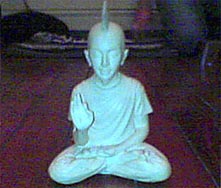
While Wu Tang’s philosophical references began with martial arts films, their inspiration validly comes from yet another, older, bad ass group – the Shaolin Monks. There is nothing wimpy about this club. Meditation is their way of life, creating focus, discipline and a centeredness from which they move. I can safely say a 60 year old man able to meditate while balancing one finger…is hardcore.

While meditating on your head might not be in the cards, there is still much to learn from their way of life. For example, here in this video are the simplest elements needed to meditate.

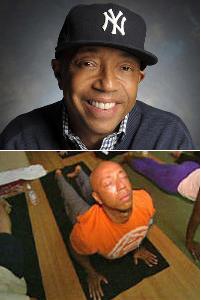
Russell Simmons

Of course, meditation has its celebrity fans. Tiger, Russell Simmons, Sting. Hands down, my personal favorite is David Lynch. Here is a guy who goes fishing into the human psyche, catching all the dichotomies (good and evil, black and white, etc) and exploring them in wild nonlinear, multidimensional ways. Doing things like this:

…while meditating twice a day for the past 35 years. Lynch is one of the most prolific artists out there today. Disturbing, beautiful and compelling. Taking concepts and running with them in various directions. Lynch is a badazzzz.

In the end I defer to The Man, Clint Eastwood. Yup, Mr. Eastwood has been practicing meditation everyday since the 1970’s.

So I gotta ask, Do you feel lucky Punk? Well do ya?

If not, perhaps a little mediation would help….

(I know. Oh so cheesy cheese, but hard to resist.)

Here are a few links for more information:

2009 Scienceline Article

June 2010 – Diane Rehms Show on the power of meditation

The NIH overview on Meditation

ACL Pre/Post Surgery Knee Exercises

Torn ACLs and knee injuries are surprisingly common, and a prime example of how muscular imbalances create wear on the joints. Proper awareness, balance, and strength training are key to preventing and rehabbing any and all injuries… knees included.

For a knee injury, it is important to build the entire leg: maintain quad strength, build stronger hamstrings, and focus on balanced strength in the hips. Pay attention to proper traction and alignment of the ankle, knee and hip as you exercise – in other words, make sure everything is lining up. You can easily do a movement, but without proper alignment of the joints, muscular imbalances can be created, resulting in continued strain.   The best way to build overall strength and better alignment is to incorporate some form of balance into your exercises. Balancing coerces lesser developed muscles to engage, as well as to kick in a little core support.

Your doctor or PT will probably gave you some similar movements, like squats, leg presses, and lunges, but my recommendation would be to try to incorporate an element of balance with each:

Wall Squats with a balance ball behind the back – Angle out the legs and work your way to bringing them under your hips. Pay attention that the knee lines up with the center of your foot. Don’t let the knees extend into flexion past the toes, or a 90 degree angle. Hold the squat for 30 seconds.

Single leg wall squats – This is a challenge. Be careful with these.


Standing on one foot Hip hikes
– Using a yoga block, encourage balance work on the standing leg. allow the opposing leg to tap the floor and lift up. Works the hips and standing leg stability.


Balance on one foot
– Balance on an upside down bosu ball, foam roller, or a wobble board at the gym
Practice balance on this for 30 seconds to 2 minutes at a time.


Lunges with bosu ball – You can flip the bosu either way.  Arm movements are optional.  Here’s an alternative with the Bosu Ball flipped.

Swimming over balance ball – Lying over the ball. Core is centered. Opposing hand and leg lift, other two remain in contact with the floor. Hold for 5-10 seconds each. Keep both arm and leg completely straight, hold and balance. Switch.

Hamstring curl, pelvic lift series on balance ball or bosu ball – Lying on the floor. Soles of the feet flat on the ball (don’t hang in just heels), curl hips up towards the ceiling and roll back down through the spine. Keep ball stable. Can do with legs together (harder) or shoulder width apart. Curl up and down 10 – 20 times.
1. Next progression: you can keep hips elevated and carefully push the ball out and in. Don’t move hips as you move legs. Be careful with this one.
2. Next progression: you can do single leg pelvis lifts, with opposing leg stretched upward towards the ceiling – again, be careful with this one.

Leg presses on the gym equip. Don’t just power through. Keep body aligned and lengthen spine and low back away from the leg movement.


Foam Roller IT band massage If you have a foam roller at the gym, you might want to roll out the outside of the leg. Actually, investing in a roller for home is a wise purchase. There are a multitude of uses and benefits. Rolling out the IT band can be painful, depending on how tense is. The roller helps release hip and leg tension, while reducing strain on the knee.

Psst! Sneak in Some Fitness Today

Just like with saving money, or cutting calories, the little things count. I believe people receive more benefits doing small things for themselves throughout the day than dedicating an hour to the treadmill. Little breaks and movements create appreciation and respect for our bodies, helping both the body and the mind. I encourage you to find your own creative ways to keep things moving. Here are a few simple starters.

Idea  #1.

Walk when you can. Park far away from the entrance and enjoy a mini-leisurely walk to the store.  As a gift, give yourself an extra 5 minutes of walking time to get where you are going. Just a few extra steps and deep breaths calm the mind in a surprising way.

Idea #2.

Stairs. It’s the big “no-duh”. Take the stairs instead of the elevator. Draw your body weight up through the middle of the body, lifting weight away from your knees as you go up and down. Be aware of taking even breaths.

Ideas #3.

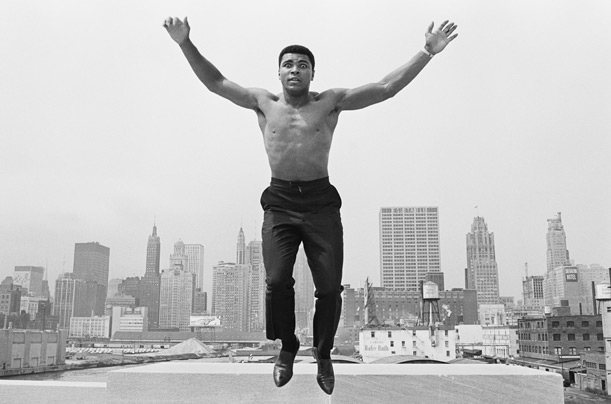
Jump or bounce around. Like Muhammad-Ali getting pumped up for the fight. Get up from your desk and just jump up and down a bit. Shake out your hands and stretch your neck. Get the blood flowing and move the computer and work stress out of you body. 30 seconds to a minute is all it takes.

Lindsey Lohan’s Health Is More Important Than Yours

Google you own name and chances are the paparrazi are not following your every misstep out of a nightclub.

Half of you stumble upon this blog by way of seeking out celeb gossip. One Pilates Studio I worked at in West Hollywood always had the latest spread of gossip mags, and most everyone, whether they themselves were celebrities or not, would sit down and read them. It’s fascinating and confounding.

Celebrity – love it or hate it – is inherently part of our human make-up. To aspire to, associate with, and to condemn. Stars summon our most human yearnings: to love, admire, copy and, of course, to gossip and to jeer.

Like Greek gods and goddesses with their individual powers and faults (Joseph Campbell would agree) celebrities are larger than life versions of us…reflections of ourselves in mythic proportions.

Leo Braudy, author of The Frenzy of Renown: Fame and its History, suggests that celebrities are more like Christian calendar saints “Celebrities have their aura—a debased version of charisma” that stems from their all-powerful captivating presence, Braudy says.

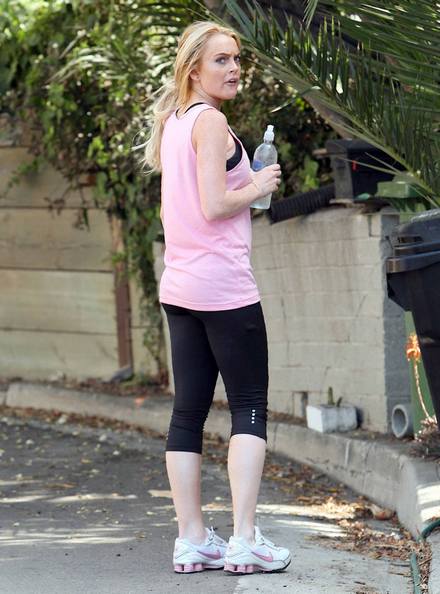
Lately the gossip spotlight falls often upon Lindsay Lohan – Patron saint of the rising star, burning out. A beautiful young starlet with the world at her feet only to be brought down by lack of boundaries, dysfunctional family, alcoholism, drugs, relationship problems, financial ups and downs…any of it sound familiar? Sure. It’s a little bit of all of us, just magnified.

Lindsay’s drama is a cautionary tale of the times, one parents can tell to their children, kind of like something from Heinrich Hoffmann’s Struwwelpeter of what happens when there are no limits and one slowly spirals out of control…a good girl gone bad.

I would never suggest to stop reading gossip mags. How could we? Celebrity fascination is part of what makes us human. It’s a mirror into our own humanity.

However, if you find that you’ve been searching the internet for well over an hour to find the latest news on Lindsay Lohan and you ended up here…Take this as your cue from the universe to get up, walk away from your computer, and do something for yourself.

Your health is more important.

The Science of Living a Healthy Life

In case you missed it, The Wellness issue of NY Times Magazine came out last week.

There is, of course, loads of fodder for healthy living; relationships, mental health, exercise, the food critics diet, and even a little interview on the many joint replacements of Jane Fonda.

The article Weighing the Evidence on Exercise promotes the long term metabolic and health affects of exercise, and shuns the assumption exercise will immediately aid weight loss.  Out of this entire wellness magazine, the last sentence in the above article proved most striking.  It is a quote from Associate Professor of Kinesiology at U Mass, Amherst, Barry Braun, and his words speak volumes:

One thing is going to become clear in the coming years, Braun says: if you want to lose weight, you don’t necessarily have to go for a long run. “Just get rid of your chair”.

What does that mean?

Let’s be clear. It doesn’t mean a treadmill desk is going to be the answer to life’s problems.

What it does means is all the little things we do throughout the day add up to make a big difference. It means, keep moving!

“Getting rid of the chair” means balancing our relatively recent technological advances with what the human body is built to do: move.   We have not yet evolved to large brain blobs being fed by tubes and hovering in glass jars, so might as well keep those limbs working.  If we open up to new concepts and ideas regarding balancing our lifestyle choices (changing dated habits in our work, family, home and school schedules) the world will follow suit. Afterall, the world is our playground, not our work station.

Perhaps the new motto for the next decade should be: “Sit Less. Live Longer.”

…Or for those with a darker sensibility in the aging spirit of post punk I like “Sit still and die.”

Your own genius suggestions are highly encouraged.

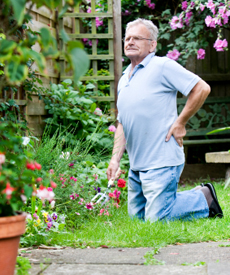
The Gardener’s Workout

It’s officially Spring…The season of Golf and Gardening backs pains.

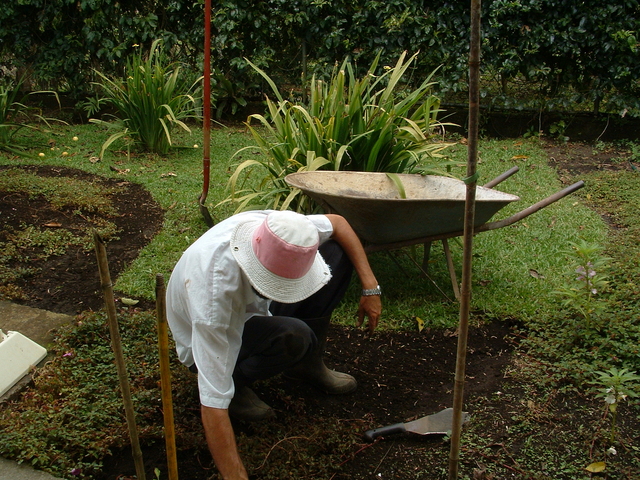
Warm rays from the sun bring the need to weed, rake and plant. The one thing my gardening clients have taught me is that pain will not hold them back. The gardening must go on.

When engrossed in an activity like gardening we often lose personal awareness, which is partly why it is so appealing. Nevertheless, by the end of the day we regain that awareness quickly when a stiff back or neck presents itself.

What to do?

Here are a few tips and exercises to keep you in peak gardening condition for as long as possible.

– Use a Timer!

Get the timer out of the kitchen and bring it with you. Every 20 – 30 minutes, stop. Do some stretches. Change position and/or activity. Is it annoying to have to stop and move around? Of course it is, but keep in mind this will save you some aches, pains, and several more years of gardening.

– Mix it up

As mentioned above, change position and activity regularly. Multi-task. Instead of focusing on getting the yard raked in one day, spread it out along with a few other “have tos” over several days. This way your body is not stuck in one position or a repetitive motion for hours on end.

– 7th Inning Stretch. The Mid Gardening Workout

When your timer goes off and your body is craving a stretch. Here are 4 great movement options:

#1. cat and cow/ #2. child’s pose

Cat and Cow / Child's Pose

#3. quad stretch

Quad Stretch. Press your hand into the fence or wall for stability.

#4. elbow stretch circles ( from one minute movement)

– Gardening core strength.  The Pre/Post Gardening Workout

Your core is not your just your belly. It is the entire ring of muscles around the trunk and can even include muscles of the thighs and shoulders. 5 to 10 minutes of simple core strengthening exercises done both morning and night might help in preventing back aches.  Here are 6 exercises that will help:

#1. The Spine Extension and #2. The Forearm Plank (from the Easy TV workout)

#3. The Dead Bug Exercise (from Finding Your Fulcrum)

#4. “Clamshells” Side Lying leg movements

Lying on your side, bend the knees and make sure neck and shoulders are comfortable. Keeping feet together lift the top knee. Do not allow the pelvis to rotate backwards, torquing the back. The goals is to move only the leg, keep the pelvis and back stable. 10 to 20 times on each side.

Clamshells. Neck is long and relaxed. Pelvic bones push forward. Back is still. No twisting.

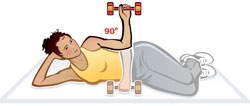
#5. “Chicken Wings” Side Lying External Shoulder rotations

Remain lying on the side. Using a light weight ( no more than 3 lbs.). Keep elbow glued to the side ribs as the forarm rises and falls. Shoulders stay down. Neck stays long. 20 on each side.

Chicken Wings. keep neck long and elbow in side.

Another view

#6. Wall Squats

Are a great way to build gardening strength while working proper knee and hip alignment. With or without a fit ball, Stand with feet shoulder width apart. Keep knees in line with toes as you bend downward. It is safest not to go past a 90 degree angle. Keep the tailbone reaching down to earth and the belly button scooped upwards towards the back of the ribs. Try 10 squats.

Wall Squat

Consider a back brace or corset support while gardening

It might not cure your back problems, but a brace or core support will remind you to stay aware of proper back placement when leaning over or squatting outside. It will help you be aware of your back.

– If all else fails, ask for help!


Get some help already!  I know you love to do it yourself, but it’s not worth the pain and perhaps ultimately having to cut gardening out all together. Plan, design, organize and get some minions at your disposal.

– More Information

A great website with wonderful ergonomic tools and ideas is offered through the University of Missouri Columbia, called Gardens for Every Body.

Happy Gardening!

Control

Teaching Pilates exercises is easy. They are exercises. Teaching clients to control their muscles in Pilates is difficult. Really difficult.

Little known fact: Joseph Pilates named his exercise program Contrology – The Art of Control.

Just because someone looks good doing an exercise, does not mean they are performing it correctly.  In Pilates we are taught to work from the core of the body outwards. Muscle control in Pilates, and for pretty much any movement, should begin with a fundamental understanding of the trunk….or as popular vernacular goes, the core.

This understanding, or awareness, of muscles is created by mind-body connections. It’s nothing new-agey or other worldly. It is a combination of cognitive function, motor skills, and neuromuscular training. Being aware means you have knowledge of a muscle and are able to contract it on command.  Muscles do have memory.

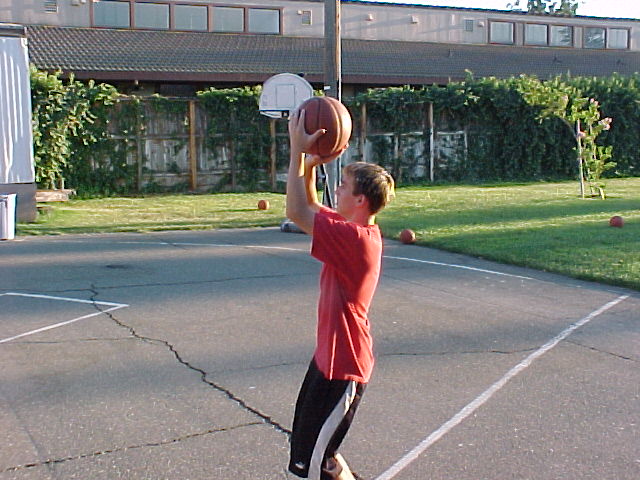
Example: Close your eyes and imagine shooting a basketball into a basket. You can mentally create the action. Hands holding the ball. Feet in proper stance. Knees bend.  Energy builds. Push off. Arms extend. And you shoot the perfect three-pointer…whether or not you made that mental basket is best left for a psychologist’s blog. Point is, you can feel the movement without moving.  That is muscle memory.

A large part of a Pilates instructor’s job is finding the right key to help you unlock mind-body connections. The key could be a word, or an image, or a feeling, but once able to contract or lengthen the specific muscle upon command, you have now created new muscle memory.

Eric Franklin is a movement educator creating mind-body connections by playing with imagery. Franklin supplements movement training with brain and body exploration. Again, it sounds new-agey. Trust me. It’s legit. Connecting creative thought patterns and feelings with the physical body can bring about new muscular connections. Franklin’s methodology is a nice complement to any Pilates, physical therapy, or exercise practice. Subtle imagery cues can make a large impact on muscle control down the road. Starting small in your movement is a sound way to begin proper muscle control.

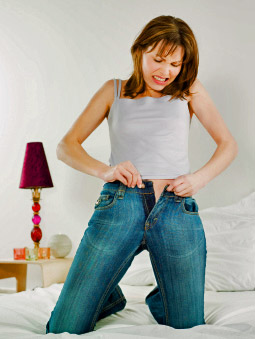
Classic Pilates imagery cue: Imagine you are trying on a pair of tight pants. The zipper is almost zipped. There is about one inch left.  Take a deep breath and draw everything up and in so you can draw that last little bit of zipper up!

This image helps people feel the deep abdominal muscles. Once felt, it’s easier to understand how to contract them at will.

Attaining muscle control and knowledge of your own body keeps you strong and flexible.

So how do you begin?

#1. Your best bet is to start working with a knowledgeable trainer. Let them help you assess your body and find the best way to progress. Every body is different and to find your particular muscular control pattern is a personal battle.

#2. Practice small fundamental movements regularly to create more mind-body neuromuscular connections. IDEA Health and Fitness Association offers a nice list of some tried and true core connecting moves. Pick one or two that work for you.

For more information on the Eric Franklin and his movement method, check out his website.

1 Minute Movement Break – Try this Now

Stop what you are doing! Take a one minute movement break, and try this simple move below.

Keeping with the recent upper body theme, here is a great movement to relieve neck and shoulder tension while promoting shoulder mobility.

Elbow Circles.

Elbow Circles:
Gently touch fingertips to shoulders. Reach outward to opposite walls through your elbows. Draw large smooth circles in space with the elbows. Take Deep Breaths. Keep you head floating up towards the ceiling.
Enjoy the stretch and movement. Take one more deep breath. Now go on about your day…

The Weight of the World off Your Shoulders

Shoulder fun fact: The shoulder blades are not connected to any other bone in the body, but fixed in the body with merely a few muscles.

The human shoulder is crazy complex. It’s built for movement and dexterity. Countless problems stem from imbalances within it’s fine inner-workings. The most prevalent shoulder problems stem from sitting all day. Go figure.
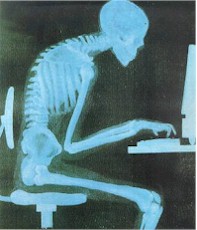
Whether standing or sitting, the human body is built to turn inward; naturally possessing more muscle mass that turns us inward than outward. Perfectly formed to slump back in a chair, or round forward over the desk. Sitting this way from kindergarten through now at your computer, it’s a safe bet you’ve experienced neck and shoulder tension.

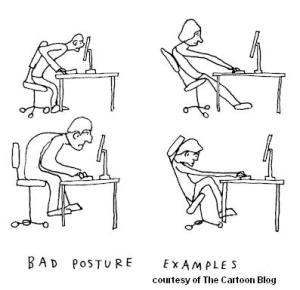
When focusing on upper back strain, it is important to remember the body compensates as an entire unit. No muscle is an island unto itself. Pain manifesting in the neck and shoulders could be created, in part, by the tightness and tension in the hips and low back. This is why posture is so crucial.  Proper posture elongates and disperses the muscle work of holding up the body against gravity evenly.  See the below examples and its easy to get the gist:
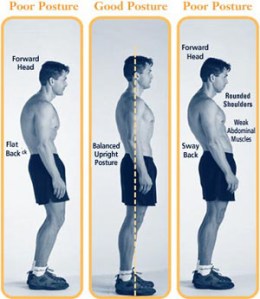
We are so used to allowing our neck to tense and our shoulders to round forward, that they take over everything we do, down to our abdominal exercises.

TRY THIS TEST: Sit on the floor. Bend your knees together. Try curling half-way back, scoop the belly, and hold. See if you can completely relax your shoulders and hold the curled position.

If your fall backwards = Your abdominals are weak and the upper body pushes you through most core movements.

If your legs pop up = your hip flexors are tense

If you can hold the position = you should feel deeper core engagement by releasing the shoulders

Roll Down Test (notice how the front of the neck stays open and the knees do not move)

Our shoulders and hips can act like a barrier surrounding the core muscles. To strengthen the core of the body, we must learn to let go of tension. Pilates and muscle awareness helps correct this by building strength from the inside out.

Now back to the upper back! This post simplifies (perhaps overly so) the complexity of the shoulders in order to create achievable goals with a few easy exercises. Besides a tall overall posture, you need awareness of the following muscles to do the movements:

Muscle of interest #1 – The Rhomboids. They pull your shoulder blades together. Imagine cracking a walnut between your shoulder blades, those are your rhomboids.

Rhomboids

Muscle of interest #2. – The Latissimus Dorsi. They connect the upper body to the hips. Imaging drawing you armpits towards the hips, those are your latissimus dorsi. Strengthening these muscles will help allow for a stretch in the upper back and neck.
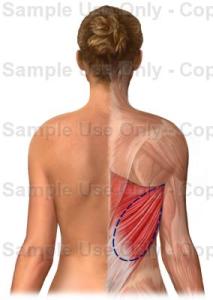
Latissimus Dorsi

Engaging the rhomboids and the latissimus dorsi (lats) allow neck and shoulder tension to release and that energy to be channeled into shiny new postural alignment.

Try this: Imagine drawing the shoulder blades down and together creating the point of a V at the mid back. Feel the chest stretch open, while constantly allowing your head to drift up towards the sky. This simultaneous contraction and stretch allows for deeper breathing and over all better well being. One note: Don’t force or hold for too long. Gently contract, hold for a moment, then release. Keep at it.

I recommend investing in an elastic band.

Here are 3 elastic band exercises balancing upper body strength, using that tall, core-engaged posture, the above muscles, and while stretching the neck and shoulders:

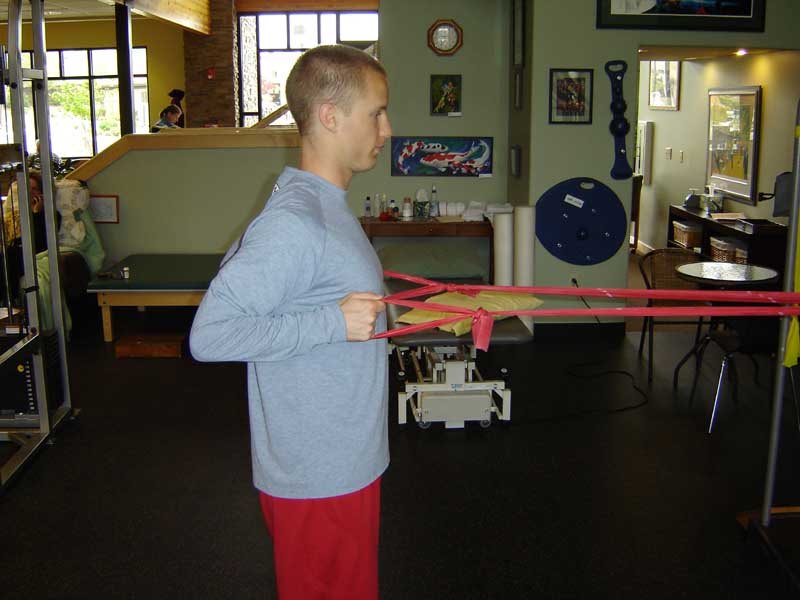
Shoulder Shrugs: Stand on the band, arms by your side. Shrug shoulders up and down, allowing band to gently stretch the shoulders downward. Head is constantly drifting up towards the ceiling.
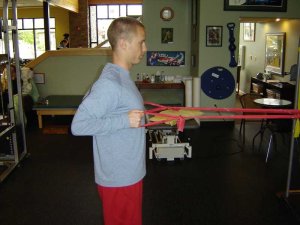
Rowing: Wrapping the band securely around a door knob or fixed point. Lead elbows back towards each other. Head is lifted. Shoulders squeeze back.Crack the walnut between shoulder blades.

Chest Expansion: Wrapping the band securely around a door knob or fixed point. Draw straight arms down and back. Aiming fists towards your heels. Squeeze shoulder blades together. Head drifts upward. Neck is long.

Another small view of chest expansion

More details on these and other exercise can be found at here and here.

A few simple, quality moves with moderate weight (or resistance) and a focus on breath is far better than a massage or a static stretch for releasing neck and shoulder tension. Building proper muscle strength gives the tension a place to live, rather than allowing it to set up camp in your neck a few hours later. Quality of movement is more important than quantity.

Find little movements all day long that create length, strength, and stretch.


Resolve

To do more of nothing.

Take time to be still.

There is wisdom in silence.

明けましておめでとうございます

(Happy New Year)

From Mind Body Arts