Tag Archives: core

Try This – Balloons of Strength

Blow up balloons.

You heard me. Get a cheapy pack of 100 and blow up about 20 to 30 in one sitting.

Blowing up balloons is a resistance based exercise for the diaphram, a key muscle not only for breathing, but for overall core strength. If the trunk muscles are weak, the diaphram suffers (and vice versa), as does your breathing…as does your neck and shoulder tension, as does your stress levels….see how all of this is an endless spiral?

Increase your lung capacity. Strengthen the diaphram. Build core strength. Release neck and shoulder tension. Let go of stress easier by breathing deeper.

Seems we have nowhere to go but up….go blow up some balloons.

Control

Teaching Pilates exercises is easy. They are exercises. Teaching clients to control their muscles in Pilates is difficult. Really difficult.

Little known fact: Joseph Pilates named his exercise program Contrology – The Art of Control.

Just because someone looks good doing an exercise, does not mean they are performing it correctly.  In Pilates we are taught to work from the core of the body outwards. Muscle control in Pilates, and for pretty much any movement, should begin with a fundamental understanding of the trunk….or as popular vernacular goes, the core.

This understanding, or awareness, of muscles is created by mind-body connections. It’s nothing new-agey or other worldly. It is a combination of cognitive function, motor skills, and neuromuscular training. Being aware means you have knowledge of a muscle and are able to contract it on command.  Muscles do have memory.

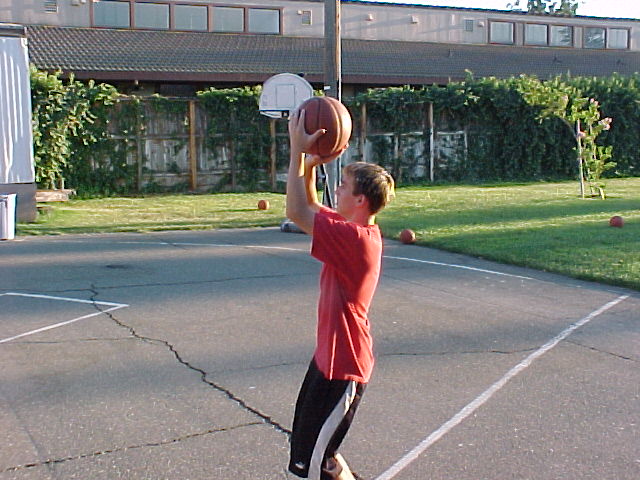
Example: Close your eyes and imagine shooting a basketball into a basket. You can mentally create the action. Hands holding the ball. Feet in proper stance. Knees bend.  Energy builds. Push off. Arms extend. And you shoot the perfect three-pointer…whether or not you made that mental basket is best left for a psychologist’s blog. Point is, you can feel the movement without moving.  That is muscle memory.

A large part of a Pilates instructor’s job is finding the right key to help you unlock mind-body connections. The key could be a word, or an image, or a feeling, but once able to contract or lengthen the specific muscle upon command, you have now created new muscle memory.

Eric Franklin is a movement educator creating mind-body connections by playing with imagery. Franklin supplements movement training with brain and body exploration. Again, it sounds new-agey. Trust me. It’s legit. Connecting creative thought patterns and feelings with the physical body can bring about new muscular connections. Franklin’s methodology is a nice complement to any Pilates, physical therapy, or exercise practice. Subtle imagery cues can make a large impact on muscle control down the road. Starting small in your movement is a sound way to begin proper muscle control.

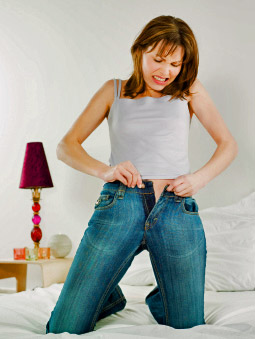
Classic Pilates imagery cue: Imagine you are trying on a pair of tight pants. The zipper is almost zipped. There is about one inch left.  Take a deep breath and draw everything up and in so you can draw that last little bit of zipper up!

This image helps people feel the deep abdominal muscles. Once felt, it’s easier to understand how to contract them at will.

Attaining muscle control and knowledge of your own body keeps you strong and flexible.

So how do you begin?

#1. Your best bet is to start working with a knowledgeable trainer. Let them help you assess your body and find the best way to progress. Every body is different and to find your particular muscular control pattern is a personal battle.

#2. Practice small fundamental movements regularly to create more mind-body neuromuscular connections. IDEA Health and Fitness Association offers a nice list of some tried and true core connecting moves. Pick one or two that work for you.

For more information on the Eric Franklin and his movement method, check out his website.

Understanding Your Balance Creates Strength Control and Flexbility

711099.widec

You may have heard of the 42 year old Beijing Olympic Swimmer Dara Torres, who attributes much of her training success to resistance stretching. Bob Cooley is one trainer who created a system of movement around this concept, Meridian Flexibility system. Before this in the 1950s the physical therapy concept of PNF stretching was created to help people retrain muscles with isometric contractions followed with passive stretches of muscle to improve range of motion.

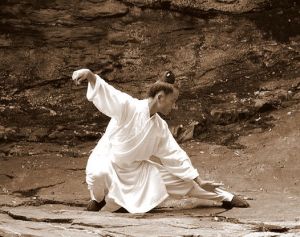
At the early part of the 20th century, Joseph Pilates created his own resistance training method combining Western calisthenics with Eastern movement principles, working from the inside out and elongating muscles outward as they were being contracted simultaneously in order to maintain core stability. Go further, a thousand years or so, and we find the concept of muscular balance and flow, stretch and strength, yin and yang, in movement arts throughout Asia, such as in Tai Chi and yoga.

tai_chi

The idea of stretching and strengthening simultaneously is not new. But it seems to be a hard lesson to learn. Brainpower is a necessity. It requires patience and knowledge of one’s own body. Most of us do not seem to have time to invest in ourselves, although it would reduce injuries and add to our active lifespan.

In my ten years of teaching pilates i have found several truths about people and our bodies.  One in particular is: flexible people love to stretch and tight people like to strengthen. Funny how we do. A very broad example is that it’s very hard to get a runner to slow down, become internally aware of deep muscles and breathe. It’s also a huge challenge to get a yogi to speed up, not to over think, and push their strength training more while forgoing lots of stretches. Part mental, part physical in both cases.

There must be a balance of both stretch and strength, body and mind to create true balance.

In any exercise you do, look for a lengthening, stretching muscle, reach against gravity. Use awareness and gravity to create resistance. If all you feel is a passive stretch, explore the muscles which should be contracting in their length to support the stretch. Don’t just hang out in a stretch! This is what is meant in muscular balance.

Don’t force a stretch, and don’t force a muscle to be in a certain place. These things come with time. Forcing your body (and mind) into place will not create sound balance any sooner. In fact, it might impede it.

Here are two moves, from previous posts, to help you contemplate your own balance.

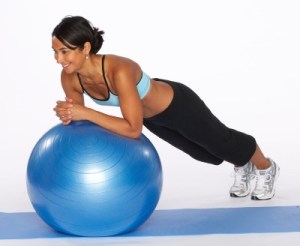
#1. The Forearm Plank ( detailed in Hip strain post)– test strength, learn to release tension in difficult situations and find the stretch. I go to this again and again, but it is a safe test for strength, balance, and control for the entire body.

core-abdominal-and-lower-back-exercises-28

forearm plank(1)

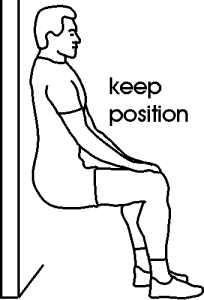
# 2. Wall Exercises for feeling your postural muscles stretch and strengthen ( detailed in Spinal Stability post)

wall squats

Want a stronger back? Stop fixating on abdominals.

images-10

An article appeared yesterday in the New York Times Magazine discussing the myths behind doing deep abdominal crunches for a strong back.

I couldn’t agree more. When repetitively overdone, such exercises can create new injuries.

DON'T DO THIS

DON'T DO THIS

Think of your core as your entire trunk, front, back and sides, beginning just below the collar bones and going all the way down to the back of the inner thighs, just below the gluteus maximus. Your whole body coordinates to create a length, strength, and flexibility.

Here are a good guidelines to keep in mind.

#1. Don’t over do one exercise. There is no magic exercises creating perfection. A few well done, thoughtful exercises are better than 50 sloppy ones.

#2.  Play with gravity in your movements. Make sure to strengthen and lengthen all the muscles of your trunk. Do some sitting, standing, lying down (front and back), or balancing.

#3. Mix up your routine. Don’t get too comfortable in one series of movements. Challenging your brain and muscle memory is key in staying strong. Every muscle counts, each one helps another to do its job.

#4. Moderation. Start small, slow and steady. If you push out the gate too hard, you could injure yourself, or get frustrated very quickly.

DO THIS

DO THIS

Here are some excellent moves from the New York Times online article. Anyone who takes mat classes with me will recognize several of these movements. These movements can be modified based on injuries or weaknesses. For more beginning exercise routines, check out the post on The easy tv workout.

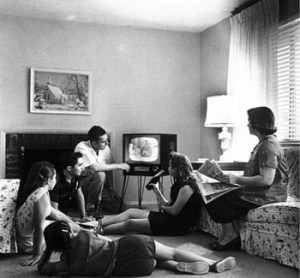
The Easy TV Workout

lect11_5

Missed your workout today, but not your favorite tv show?

So you’re at home watching The Housewives of New Jersey, or Mad Men, or Thirty Rock, or whatevers, and commercial break hits. Instead of hitting fast forward on your DVR, challenge yourself to my commercial break workout. Quick, easy, nothing is missed but some couch potato intermission drool.

The average commercial is approximately 30seconds. Most of these challenges require about 2 -4 commercials, although you could go the entire commercial break if you choose at some point. At this rate you could be getting in 5 minutes of exercise a day. Enough to make a difference in a week. You’d be surprised! Take the challenge!

BREAK #1. EXTENSION with Arm Push (Adapted from Somatic Patterning by Mary Ann Foster)

The arm push will strengthen rounded shoulders. Lying on your belly. Put both arms to the sides and bend your elbows. Palms are flat and all 5 fingers are touch floor! Widen and sink across the front of your chest. Reach your elbows out to the sides to widen across your shoulders. Keep your neck long by reaching out the top of your head. Slowly press your entire hands and forearms into the floor. Sense the force of the push traveling up your arms, into your back and down your spine Continue to push your arms down and out into the floor and raise your head and chest off the floor. Keep the back of your neck long. Let your chest feel broad, your neck free, and your spine feel long. The shoulder blades should be drawn together behind you. The arms stay straight. Hold for at least two commercials. If you feel pain in your back, walk your hands out in front of you further, or prop your belly with a pillow.  If you feel pain in your gluts or legs. Stop.

Extension with arm push

Extension with arm push

don't do this

don't do this

BREAK #2. FOREARM PLANK CHALLENGE

Nothing fancy about this one. Tried and true. Do not do it on your hands, thinking you are making it harder. On the hands is actually easier for your to avoid your core and to tense your shoulders. The forearm plank is good core stability work. Lengthen in the position. Keep stretching your chin and neck past your fists. Keep your armpits reaching for your hips. Hold at least 2 commercials.

Plank

Forearm Plank

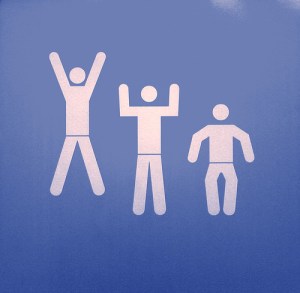
BREAK #3. JUMPING JACK CHALLENGE

You know how to do them. So go for it. How many can you do in a commercial break?

Little tips: Try to keep your neck tension free by reaching through the crown of your head towards the ceiling. Pull your belly button to the spine to help from placing too much tension on the knees.

JUMPING JACKS

JUMPING JACKS

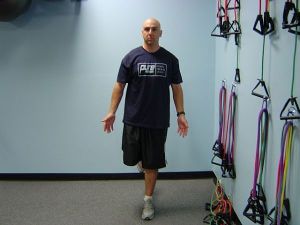
BREAK #4 BALANCE CHALLENGE: Balancing on one leg and toes

Practice you balance by standing on one foot for one commercial break. Shift to the other foot for the next commercial. And then balance on your toes for the third  commercial. You can always extend the time. Keep the thought of lift the spine and your posture in mind as you practice your balance. Let your eyes look up to where the wall and ceiling meet to help keep your neck long.

balance on one leg

balance on one leg

Balance on your toes

Balance on your toes

There you are. Not only did you get your tv time in, but your work out as well. Who knows? Maybe it will catch on and become the party game of every tv show watching party across America. Okay. So I’m dreaming big. You could also challenge your kids or grandchildren as well. No matter what, just have fun with it, perhaps making up your own commercial break workouts. Good Luck!

The Dawning of the Age of Golfers

golf mustache for wind resistance

Pilates and Golf.

Unless you’ve been living under a rock, you might have heard of this popular combo.  I must fully agree with the pairing.  They both require the same skills: mental and physical conditioning from the inside, outward to the external.  In other words, practicing how you respond to your surroundings.

Unfortunately, like in most things, there is no magic spell to make this happen. It requires mindful repetition of movements which allow you to change and control your own habits without over-thinking, no matter what the external challenges might bring.   To be done properly, both golf and Pilates require precision controlled movements flowing outward from a strong and flexible center. One compliments the other indisputably. To create control and precision movements, one needs to be able to breathe properly, releasing tensing muscles, and quiets the active mind.

Living in the Midwest now, I realize golf is seasonal, as opposed to the West Coast, where it flourishes year round.  So now is the ideal time to start prepping body and mind for the upcoming season.  One movement every golfer needs to work on is twisting properly. My explanation here of twisting is pretty rudimentary, but this should convey the general concept. Keep in mind, just like with the English language, there are always exceptions to the rule.

In Pilates, the basic concept of twisting starts with the axis of the spine. Along the spine axis we have two attached bones structures we will focus on: the rib cage and the pelvis.

Twisting to stretch the back and strengthen the obliques, one must either A. Twist the rib cage, and stabilize the pelvis, or B. Twist the pelvis and stabilize the ribs. When we attempt a twist without stabilizing one part of the spine we often end up with back injuries. The twist of a follow through in your swing is only executed properly with the ability to stabilize ones pelvis  even as it moves with the spine. Hmmm. tricky. But, possible. Think of a rubber band: In order to stretch it, one point must be fixed. If both points are unstable, it’s a wet noodle. If both points are fixed, it is rigid and doesn’t move.

So how do you practice twisting?

Warning: Be careful and do not over do any exercise. I recommend only 3 sets. (1 set is a twist in each direction). If you have any back pain, do not do this exercise until you consult a professional.

Sitting on a large balance ball. Both feet and knees about shoulder width apart. Arms can stretch out to the sides, rounded in front, OR you can place one hand on top of the other on top of the head. Twist the rib cage to the right, but DO NOT MOVE THE BALL OR YOUR LEGS. This will limit your twist, so that you are twisting from your obliques and not your hip flexors. Repeat to the left. The stability of your legs, backside and the ball is more important than the amount of rotation from your chest. As you twist, think of spiraling up towards the ceiling, rather than twisting back behind you. Remember: twist up, not back. twist-on-ball

For the more advanced student, it can be done on the floor, keeping both legs glued together and the spine lifted up towards the ceiling.
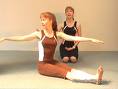
spinetwist1

Spring and Summer 2009 I will be giving several workshops on Pilates movement for golfers. Please check back under classes and workshops to find out when and where. If you are interested in hosting a Pilates and golf workshop, please email me at: pilates@stephanieellison.com